I have been kicking around this idea during my graphic design study for a while, since I am nothing but ambitious (and I have a few fond memories of this working before, to my benefit): to actually put in the workload for each topic related to graphic design and applied arts.
Hi. I am Mario, and I have a bachelor’s degree in graphic design, which, to you, should mean that I passed every test. And, for the sake of this project, it is best to assume that I barely made the cut each time. It is also best to assume that this applies to everyone with a degree, since scoring high grades is not what makes you pass.
A passing grade does.
So, right now, I am at the point where I am ready to actually understand graphic design (and my second interest: applied arts), and I was looking for a system, a quantifiable system of work put in, translating into workload, per week, per topic.
And that system is called ECTS: the European Credit Transfer System
Each credit in this system translates to roughly 25 hours of workload put in. A topic or lecture is worth 3 credits? That means an investment of 75 hours. 5 credits translate to 125 hours.
You can use this for yourself, independent of whether or not you actually study a course someplace.
So, you can go ahead and look online for a course giving you information about its lectures, topics, ECTS credits, and workload, and create your own schedule, at your own pace:
45 minutes every other day will very quickly beat the eight‑hour long crunches once each week, since a good schedule is about allowing consistency to take hold. I am not an educator (yet, afaik), but from what I remember the issue with these crunch sessions is that the session which came before is already barely present, its learnings vague, my progress a memory.
So, let us say that you have found a course telling you about its lectures and classes, and how they are set up. Ideally, with information about recommended literature. If you are a polyglot (and who isn’t these days?) you can again enjoy having an edge, for obvious reasons I don’t need to get into.
You have been shopping around colleges and universities around the EU, and you have found out that which interests you most, is figure drawing.
And, for the sake of this example, I’ll say that there are three figure drawing classes, called “figure drawing I”, “figure drawing II”, and “figure drawing III” respectively, valued at 5 each. To you, this means a workload of 375 hours for your absolute foundations in figure drawing (5 × 3 × 25).
Of course, to do this, you also need courses in anatomy (75 hours?), drawing (75 plus 75 hours maybe?), and painting (375 hours?) to have those foundations upon which you can build your figure drawing.
Provided you build smart (and frequent a good library in the largest city in your area), we are looking at a workload of around 975 hours.
These are study hours: learning, reading, doing.
What this translates to in terms of doing 45 minutes of work every other day, is that to get those (I assume solid) foundations in figure drawing, assuming you work 3 hours per week in total, will take you 375 weeks.
Or 6.25 years.
This seems slow. And it is. It should be. But the outcome will be the same: a passing grade in figure drawing. For only 45 minutes of work every other day (not counting your trips to the library each time you need a new book to study from).
Of course, we can look at that the other way as well: if that is the workload anyhow, why not get credits for it? They, at the very least, are proof of what you studied. And because, in our example, we just accumulated around 45 ECTS credits, you might as well have them validated and go study for real, feel me?
BTW, my graphic design study was 180 of those credits in total, so you just did a quarter of the points needed for completing a bachelor’s degree.
Huh. This was insightful. For both of us, I hope.
Fragment: In meinen Entwürfen habe ich diesen Post noch gefunden
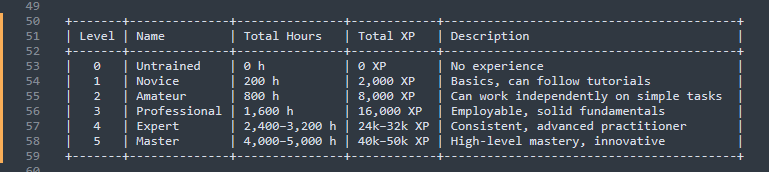
Two weeks ago, I was looking for an (tt)RPG system with which I could sort of gamify my own knowledge in studying (graphic design), as well as make (graphic design), i. e. create a quantifiable feedback system for personal self studies, for people who can get a kick out of tracking their progress in a meaningful way.
I ended up with the GURPS skill progression system, which basically looks like this (I’ll provide three different tables, because I have no idea which one renders okay on tumblr):
+-------+--------------+---------------+------------+-----------------------------------------+
| Level | Name         | Total Hours   | Total XP   | Description                             |
+-------+--------------+---------------+------------+-----------------------------------------+
|   0   | Untrained    | 0 h           | 0 XP       | No experience                           |
|   1   | Novice       | 200 h         | 2,000 XP   | Basics, can follow tutorials            |
|   2   | Amateur      | 800 h         | 8,000 XP   | Can work independently on simple tasks  |
|   3   | Professional | 1,600 h       | 16,000 XP  | Employable, solid fundamentals          |
|   4   | Expert       | 2,400–3,200 h | 24k–32k XP | Consistent, advanced practitioner       |
|   5   | Master       | 4,000–5,000 h | 40k–50k XP | High-level mastery, innovative          |
+-------+--------------+---------------+------------+-----------------------------------------+
LEVEL 0 — UNTRAINED
0 h • 0 XP
No experience.
LEVEL 1 — NOVICE
200 h • 2,000 XP
Basics, can follow tutorials.
LEVEL 2 — AMATEUR
800 h • 8,000 XP
Can work independently on simple tasks.
LEVEL 3 — PROFESSIONAL
1,600 h • 16,000 XP
Employable level, reliable skills.
LEVEL 4 — EXPERT
2,400–3,200 h • 24,000–32,000 XP
Advanced practitioner, strong style.
LEVEL 5 — MASTER
4,000–5,000 h • 40,000–50,000 XP
Peak mastery, innovative.
0 — UNTRAINED
▸ 0 h | 0 XP
1 — NOVICE
▸ 200 h | 2,000 XP
2 — AMATEUR
▸ 800 h | 8,000 XP
3 — PROFESSIONAL
▸ 1,600 h | 16,000 XP
4 — EXPERT
▸ 2,400–3,200 h | 24,000–32,000 XP
5 — MASTER
▸ 4,000–5,000 h | 40,000–50,000 XP
If we apply our 375 hours of figure drawing from the post above, this will put you almost halfway to amateur. But since this is GURPS, flat hours do not mean flat XP gain.
Consider the following:
Each hour spent studying gives you flat 10 XP as a base, to which you can apply these modifiers:
Warm-up / doodling Mindless, low engagement ×0.5 (5 XP/h)
Guided exercise / tutorial Medium effort, clear task ×1 (10 XP/h) Focused study Anatomy, shading drills, perspective: deliberate practice ×1.5 (15 XP/h)
Project work A real illustration/design/3D model ×2 (20 XP/h)
Portfolio piece High stakes, polished, exhausting ×3 (30 XP/h)
If you are fresh out of graphic design study, for instance, this might give you an interesting self-quantifiable feedback as well:
Each ECTS credit is around 25 to 30 hours worth of work, or between 250 and 300 XP. If a class of yours gives you 10 ECTS credits, you can assume that, in this class, you have accumulated 3,000 XP. Using our table, that puts you above novice level., but not at the level of an amateur yet.
Kind of makes sense, right? I find it neat to actually see which class or study ends up putting me where, after passing the grade.
Of course, you can translate that whole table back into ECTS credits, too:
0 — UNTRAINED
▸ 0 h | 0 ECTS credits
1 — NOVICE
▸ 200 h | 6.7 – 8 ECTS credits
2 — AMATEUR
▸ 800 h | 26.7 – 32 ECTS credits
3 — PROFESSIONAL
▸ 1,600 h | 53.3 – 64 ECTS credits
4 — EXPERT
▸ 2,400–3,200 h | 80, 96 – 106.7, 128 ECTS credits
5 — MASTER
▸ 4,000–5,000 h | 40,000–50,000 ECTS credits
Quelle: Code & Canvas
Schreibe einen Kommentar